ICE 2026 - 19th Interaction and Concurrency Experience
Interaction and Concurrency Experiences (ICE) is a series of international scientific meetings oriented to theoretical computer science researchers with special interest in models, verification, tools, and programming primitives for concurrent systems and complex interactions.
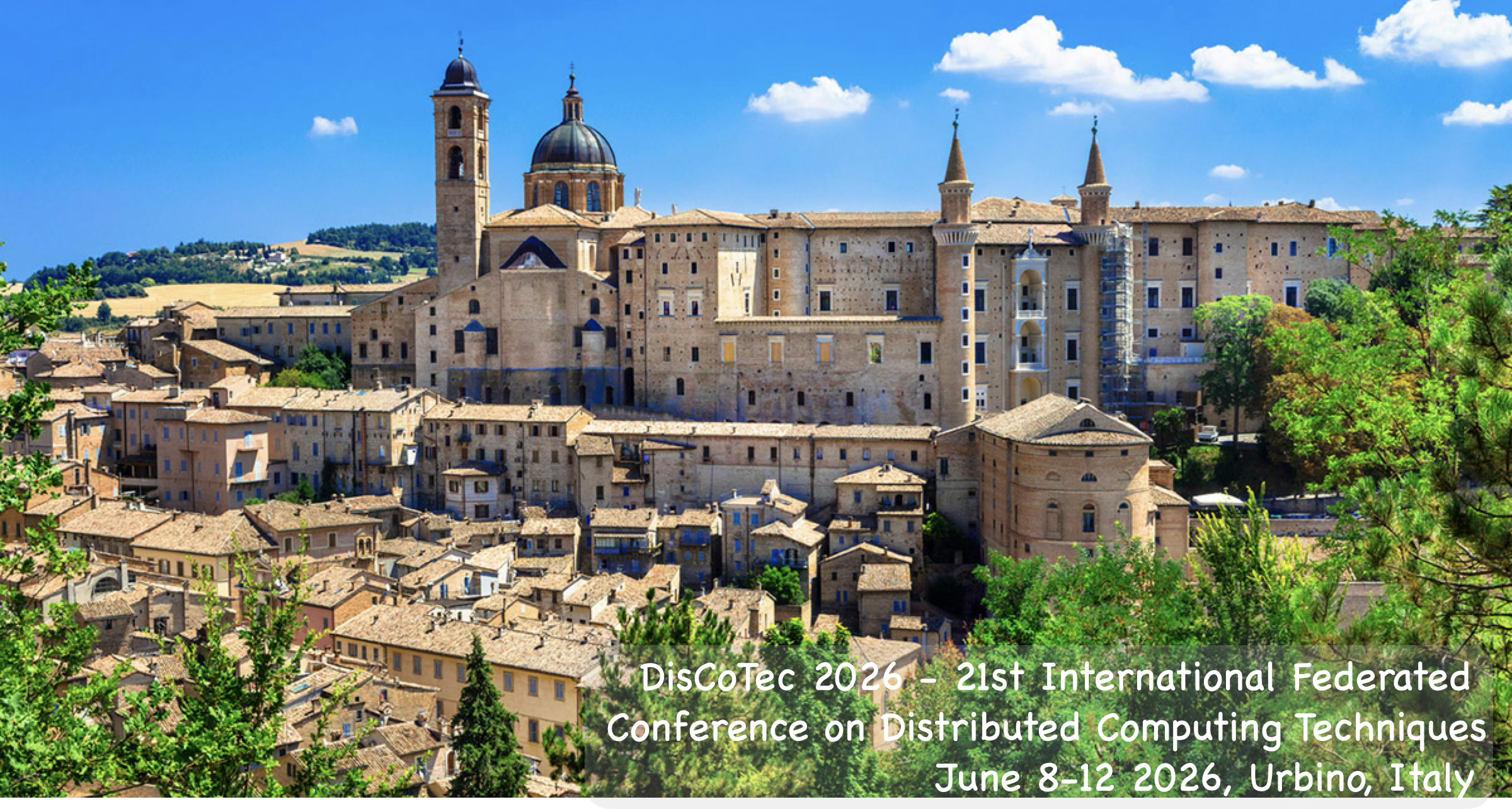
ICE 2026 is a satellite workshop of DisCoTec 2026, held on June 12th in Urbino, Italy.
Highlights
- Distinctive selection procedure
- ICE welcomes full papers to be included in the proceedings
- ICE also welcomes oral communications of already published or preliminary work
- Invited speaker: Emilio Tuosto – What do you mean A -> B: m?
- Publication in EPTCS
- Special issue in the Journal of Logical and Algebraic Methods in Programming (Elsevier) (to be confirmed)
- Contact:
ice (at) framalistes.org
Important Dates
- April 2nd, 2026 : Paper submission deadline
- April 9th, 2026 : Paper submission deadline (extended)
- April 10th - April 27th : Forum interaction, reviews, and PC discussion
- April 30th : Notification to authors
- June 12th : Workshop in Urbino, Italy
- July 12th (tentative) : Camera-ready for post-proceedings
All dates are in the Anywhere on Earth time zone.
Scope
The general scope of the venue includes theoretical and applied aspects of interactions and the synchronization mechanisms used among components of concurrent/distributed systems, related to several areas of computer science in the broad spectrum ranging from formal specification and analysis to studies inspired by emerging computational models.
We solicit contributions relevant to Interaction and Concurrency, including but not limited to:
- Formal semantics
- Process algebras and calculi
- Models and languages
- Protocols
- Logics and types
- Expressiveness
- Model transformations
- Tools, implementations, and experiments
- Specification and verification
- Coinductive techniques
- Tools and techniques for automation
- Synthesis techniques
Accepted Papers
Links below are to informal pre-proceedings.
- Safe Composition of CFSM systems via Partial Gateways by Franco Barbanera
- On asynchrony and reversibility in CCS by Hernán Melgratti, Claudio Antares Mezzina and G. Michele Pinna
- Session Type State Spaces Form Lattices by Alexandre Zua Caldeira
- A Unified Architecture for Risk Reasoning: Bridging Ontologies, Theorem Proving, and Model Checking (Oral contribution) by Stefano M. Nicoletti
- A cryptographic extension of attribute-based communication and its implementation with a secure publish-subscribe architecture (Oral contribution) by Sara Longhi, Michele Loreti and Marco Quadrini
- Modelling Shared-Space Coordination in mCRL2: a Bach-to-mCRL2 Translation Framework by Corentin Reuther and Jean-Marie Jacquet
- A Practical Approach to Verifying Structural Invariants in Colored Petri Nets by Lorenzo Capra
Invited Speaker: Emilio Tuosto
Talk: What do you mean A -> B: m?
I will cherry pick and revisit some of the results on behavioural specifications of distributed communicating systems produced over the past three decades by a large community of researchers spanning theoretical computer science, formal methods, and programming languages. No surprise my chronicle will include nICE stuff, however the goal is not (just) celebrating ICE 19th edition, rather to examine new open problems that are intriguing me at the moment. I’ll resist the temptation of diving into technicalities in an attempt to focus on the problems and keep the discussion at a conceptual level accessible to a wide audience.
Biography
Emilio Tuosto is a full professor in Computer Science at the Gran Sasso Science Institute (GSSI) in L’Aquila (Italy). From 2005 to 2019 Emilio worked at the Department of Computer Science of the University of Leicester (UK) initially as lecturer and then as an associate professor. Before moving to UK, Emilio had been a research associate from 2003 to 2005 at the University of Pisa where he also got his PhD and MSc in Computer Science.
Emilio’s main research interests are in foundations of concurrent and distributed computations. Recently Emilio has been active in the area of behavioural specifications and distributed computations. In particular, Emilio is interested in the development of theories and formal methods for the coordination of distributed systems.
Programme
All times are listed for CEST (Central European Summer Time)
| Time CEST | |
|---|---|
| 9:00-9:10 | Opening |
| 9:10-10:10 | Emilio Tuosto – What do you mean A -> B: m? (Invited talk) |
| 10:10-10:30 | Coffee break |
| 10:30-11:00 | A Unified Architecture for Risk Reasoning: Bridging Ontologies, Theorem Proving, and Model Checking (presented by Stefano Nicoletti) |
| 11:00-11:30 | A cryptographic extension of attribute-based communication & its implementation with a secure publish-subscribe architecture (presented by Marco Quadrini) |
| 11:30-12:00 | Modelling Shared-Space Coordination in mCRL2: a Bach-to-mCRL2 Translation Framework (presented by Corenthin Reuther) |
| 12:00-14:00 | Lunch |
| 14:00-14:30 | Safe Composition of CFSM systems via Partial Gateways (presented by Franco Barbanera) |
| 14:30-15:00 | Session Type State Spaces Form Lattices (presented by Alexandre Zua) |
| 15:00-15:30 | Coffee break |
| 15:30-16:00 | On asynchrony and reversibility in CCS (presented by Claudio Mezzina) |
| 16:00-16:30 | A Practical Approach to Verifying Structural Invariants in Colored Petri Nets (presented by Lorenzo Capra) |
| 20:00- | Dinner at Ristorante Locanda Del Blasone |
The ICE Selection Procedure
Since its first edition in 2008, the distinguishing feature of ICE has been an innovative paper selection mechanism based on an interactive, friendly, and constructive discussion amongst authors and PC members in an online forum.
During the review phase, each submission is published in a dedicated discussion forum. The discussion forum can be accessed by the authors of the submission and by all PC members not in conflict with the submission (the forum preserves anonymity). The forum is used by reviewers to ask questions, clarifications, and modifications from the authors, allowing them better to explain and to improve all aspects of their submission. The evaluation of the submission will take into account not only the reviews, but also the outcome of the discussion.
As witnessed by the past editions of ICE, this procedure considerably improves the accuracy of the reviews, the fairness of the selection, the quality of camera-ready papers, and the discussion during the workshop.
ICE adopts a light double-anonymous reviewing process, detailed below.
Submission Guidelines
Submissions must be made electronically in PDF format via hotcrp.
We invite two types of submissions:
-
Research papers: original contributions that will be published in the workshop post-proceedings. Research papers must not be simultaneously submitted to other conferences/workshops with refereed proceedings. Research papers should be 4-17 pages in length, excluding references. Short research papers are welcome; for example, a concise 5-page contribution is appropriate within this category. The submitted PDF can use any LaTeX style. However, accepted papers must be prepared in the EPTCS style for inclusion in the post-proceedings.
-
Oral communications: will be presented at the workshop, but will not appear in the post-proceedings. This type of contribution includes e.g., previously published contributions, preliminary work, and position papers. Submissions for oral communications should have a maximum length of 2 pages, excluding references. For example, a one-page summary of previously published work is welcome in this category.
Authors of research papers must omit their names and institutions from the title page, they should refer to their other work in the third person and omit acknowledgements that could reveal their identity or affiliation. The purpose is to avoid any bias based on authors’ identity characteristics, such as gender, seniority, or nationality, in the review process. Our goal is to facilitate an unbiased approach to reviewing by supporting reviewers’ access to works that do not carry obvious references to the authors’ identities. As mentioned above, this is a lightweight double-anonymous process. Anonymization should not be a heavy burden for authors, and should not make papers weaker or more difficult to review. Advertising the paper on alternate forums (e.g., on a personal web-page, pre-print archive, email, talks, discussions with colleagues) is permitted.
Papers in the “Oral communications” category need not be anonymized. For any questions concerning the double anonymous process, feel free to contact the ICEcreamers.
We are keen to enhance the balanced, inclusive and diverse nature of the ICE community, and would particularly encourage female colleagues and members of other underrepresented groups to submit their work.
Publications
Accepted research papers and communications must be presented at the workshop by one of the authors.
Accepted research papers will be published after the workshop in Electronic Proceedings in Theoretical Computer Science.
We plan to invite authors of selected papers and brief announcements to submit their work in a special issue in the Journal of Logical and Algebraic Methods in Programming (Elsevier) (to be confirmed). Such contributions will be regularly peer-reviewed according to the standard journal policy, but they will be handled in a shorter time than regular submissions. A list of published and in preparation special issues of previous ICE editions is reported below.
ICEcreamers
- Luc Edixhoven (Leiden University, 🇳🇱) -
luc (at) edixhoven.eu - Simon Fowler (University of Glasgow School of Computing Science, 🇬🇧) -
simon.fowler (at) glasgow.ac.uk - Rumyana Neykova (Brunel University London, 🇬🇧) -
rumyana.neykova (at) brunel.ac.uk - Violet Ka I Pun (Western Norway University of Applied Sciences, 🇳🇴) -
Violet.Ka.I.Pun (at) hvl.no
Use ice (at) framalistes.org to reach all the ICEcreamers at once.
Programme Committee
- Franco Barbanera (Dept. of Mathematics and Computer Science - University of Catania, 🇮🇹)
- Manel Barkallah (University of Namur, 🇧🇪)
- Nicolas Chappe (CNRS, Verimag, 🇫🇷)
- Matteo Cimini (University of Massachusetts Lowell, 🇺🇸)
- Christopher Esterhuyse (University of Amsterdam, 🇳🇱) ★
- Lorenzo Gheri (University of Liverpool, 🇬🇧)
- Jonas Kastberg Hinrichsen (Aalborg University, 🇩🇰)
- Ping Hou (University of Oxford, 🇬🇧)
- Elaine Li (New York University, 🇺🇸)
- Danielle Marshall (University of Glasgow, 🇬🇧)
- Maurizio Murgia (Gran Sasso Science Institute, 🇮🇹)
- Jonah Pears (University of Kent, 🇬🇧)
- Marco Peressotti (University of Southern Denmark, 🇩🇰)
- Neea Rusch (Uppsala University, 🇸🇪)
- Chuta Sano (School of Computer Science, McGill University, 🇨🇦)
- Felix Stutz (University of Luxembourg, 🇱🇺)
★ The ICE 2026 Outstanding PC Member Award was awarded to Christopher Esterhuyse!
Steering Committee
- Massimo Bartoletti (University of Cagliari, 🇮🇹)
- Ludovic Henrio (ENS Lyon, 🇫🇷)
- Sophia Knight (University of Minnesota Duluth, 🇺🇸)
- Ivan Lanese (University of Bologna, 🇮🇹)
- Larisa Safina (INRIA Lille, 🇫🇷)
- Alceste Scalas (Technical University of Denmark, 🇩🇰)
Previous Editions
For a complete listing of our previous editions, please refer to ice-workshop.github.io/#previous-editions.
More Information
For additional information, please refer to the series website or contact the ICEcreamers at ice (at) framalistes.org.