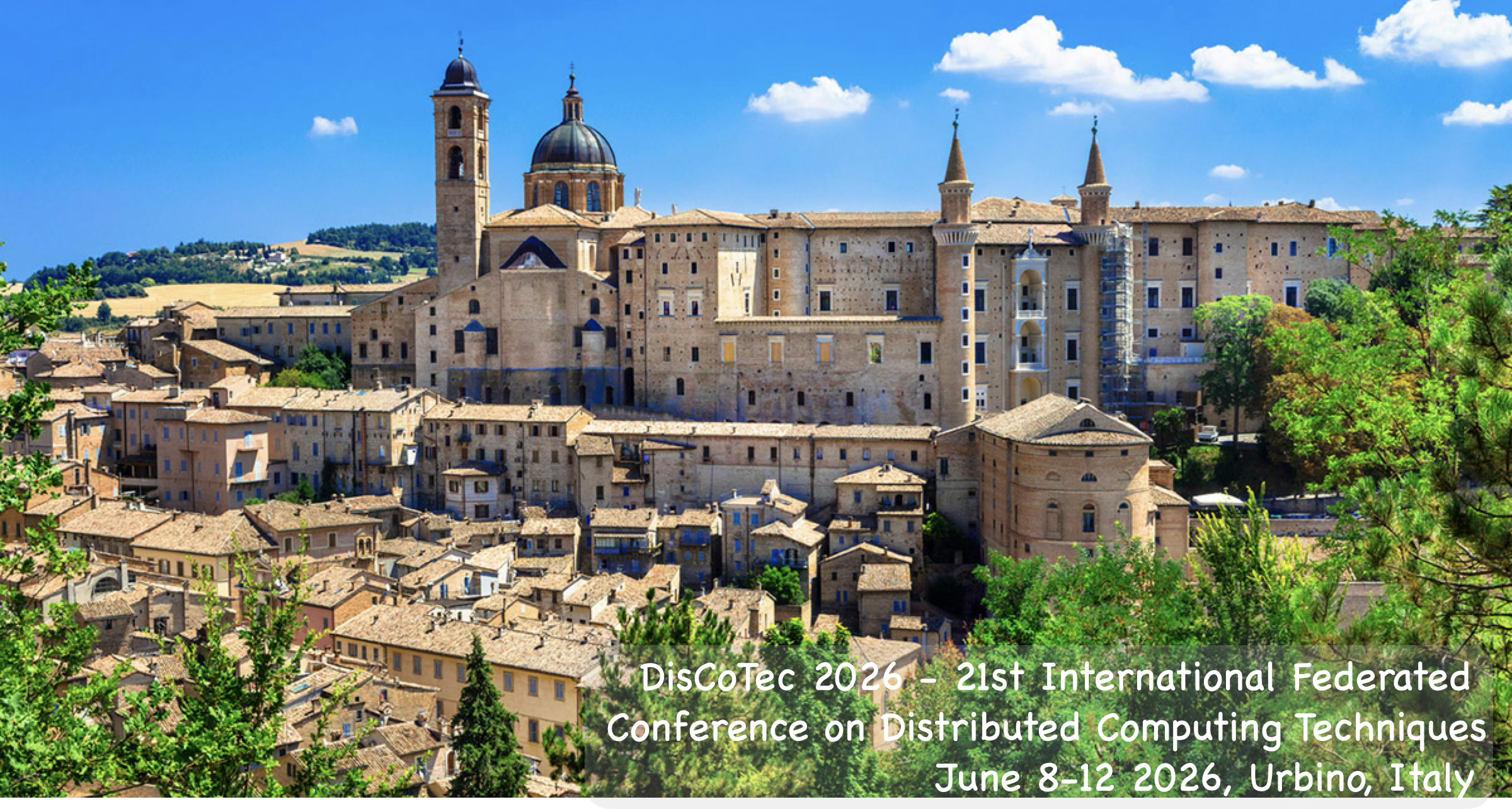
COORDINATION 2026 - 28th International Conference on Coordination Models and Languages
COORDINATION 2026 is one of the three conferences of DisCoTec 2026.
Quick Links and Updates
Dates
For papers:
- Abstract submission:
30 January 202613 February 2026 (extended) - Paper submission:
6 February 202620 February 2026 (extended) - Paper notification: 24 March 2026
- Camera-ready: 3 April 2026 (hard)
For artefacts:
- Artefact submission:
13 February 202627 February 2026 (extended) - Artefact kick-the-tires - problem reports:
23 February 20266 March 202610 March 2026 (extended) - Artefact kick-the-tires - author response:
2 March 202613 March 202615 March 2026 (extended) - Artefact notification: 24 March 2026
DisCoTec conference: June 8-12, 2026
Deadlines expire at 23:59 (AoE, anywhere on earth) on the dates displayed above.
Scope
Modern information systems rely increasingly on combining concurrent, distributed, mobile, adaptive, reconfigurable and heterogeneous components. New models, architectures, languages and verification techniques are necessary to cope with the complexity induced by the demands of today’s software development. Coordination languages have emerged as a successful approach, in that they provide abstractions that cleanly separate behaviour from communication, therefore increasing modularity, simplifying reasoning, and ultimately enhancing software development. Building on the success of the previous editions, this conference provides a well-established forum for the growing community of researchers interested in models, languages, architectures, and implementation techniques for coordination.
Topics of Interest
Topics of interest encompass all areas of coordination, including (but not limited to) foundational contributions, engineering techniques, tools, applications, and inter-disciplinary aspects.
A. Theoretical models and foundations for coordination
- Concurrency Theory, Composition, Distribution, Mobility, Time and Spatial Models
- Semantics, Logic, and Type Systems
- Probabilistic / Stochastic / Quantitative Models
- Formal Verification & Validation, and Model Checking
B. Coordination Paradigms & Languages
- Coordination Models & Language
- Session Types & Communication Protocols, Choreographies, Orchestration
- Actor and Agent-Based Systems
- Multi-agent systems, agent organisations, and societies
- Collective intelligence, Ensembles, Swarms, Self-organisation, and Emergence
- Bio-inspired / Nature-inspired Coordination
- AI-Driven & Learning-Based Coordination
C. Distributed & Pervasive & Modern Computing
- Microservices, Web Services, and Middleware
- Distributed, Reversible, Grid, Networked, Parallel and High-Performance Computing and Algorithms
- (Distributed) Run-time verification and monitoring
- Coordination across the continuum: IoT, Edge, Fog, Cloud
- Cyber-Physical Coordination, Context-awareness, Pervasive computing, Situatedness, and Human-Machine Hybrid Systems
- Decentralised systems, Peer-to-peer computing, Smart Contracts & Blockchain Applications
D. Software Engineering & Applications for Coordinated Systems
- Dynamic / Domain-Specific Software: Analysis, Models, Architecture, Patterns
- Programming Methodologies, Programming Languages
- DevOps, Continuous Integration, and Automation
- Business Process Modelling & Process Mining
- Digital twin networks, coordination of the digital thread
- Industrial Applications & Case Studies across fields (swarm robotics, vehicular networks, smart cities and ecosystems)
- GenAI/LLM-based Approaches to Engineer Coordination
E. Cross-Cutting and Multi-/Inter-/Trans-Disciplinary Aspects
- Security, Privacy, and Dependability in Coordination
- Adaptation, Reconfiguration, and Self-* properties
- Interdisciplinary & Societal Aspects of Coordination
F. Coordination Platforms, Middleware, and Tools
- Simulation Tools and Platforms
- Specification, Modelling, and Domain-specific Language Implementations and Workbenches
- Verification & Validation, Visualisation, and Testing Tools
- Distributed Middlewares and Platforms
- Datasets and Benchmarks for Coordination Systems
Programme
Consult the DisCoTec Programme. For convenience, we also report the programme plan here.
- Monday, June 8th, 14:00 - 17:00 - COORDINATION Tutorial
- Distributed Runtime Verification in Proximity-based Networks: A Tutorial on the Aggregate Programming Approach (Audrito, Damiani, Scarso, Stolz, Torta)
- Tuesday, June 9th, 10:30 - 12:00 - Session 1 - Formal modeling and analysis of distributed systems (session chair: Carolyn Talcott)
- Timed Scenario Expressions and Realisability
- HistMSO: a Logic for Reasoning on Consistency Models with MONA
- Motif Refinement for the Hierarchical Control of Structured CPSs
- Tuesday, June 9th, 14:00 - 15:00 - Session 2 - Formal verification in coordination languages (session chair: Ivan Lanese)
- Deductive Verification of Legal Contracts
- Proof of Delivery: Mechanized Mailbox Types
- Tuesday, June 9th, 15:30 - 16:30 - Session 3 - Distributed algorithms for collective adaptive systems (session chair: Maurice ter Beek)
- Aggregate Indoor Localisation
- A Self-Stabilizing Min-Max Consensus via Path-loop Detection
- Wednesday, June 10th, 10:30 - 12:00 - BEST PAPER SESSION
- Runtime adaptation as a programming pattern in service composition
- Wednesday, June 10th, 15:30 - 16:30 S4 - Simulation tools and methodologies for collective adaptive systems (session chair: Giorgio Audrito)
- Simulation and Analysis of Indoor-Air-Quality Measuring Devices with YODA
- High-Fidelity Simulation of Aggregate Computing Systems with Collektivity
- Thursday, June 11th, 10:30 - 12:00 - Session 5 - Coordination languages, frameworks, and foundations (session chair: Simon Bliudze)
- ScalaTropy: Multiparty Coordination with Monadic Communication Primitives
- Bach4Popper: Towards Federated Inductive Logic Programming using Coordination
- Phyelds: A Pythonic Framework for Aggregate Computing
Accepted Papers
The list of accepted papers follow (sorted by first author).
Regular Papers
- Yasmine Akaichi, Manel Barkallah, Jean-Marie Jacquet, Isabelle Linden and Wim Vanhoof. Bach4Popper: Towards Federated Inductive Logic Programming using Coordination
- Giorgio Audrito, Leonardo Bertolino, Ferruccio Damiani and Gianluca Torta. Aggregate Indoor Localisation
- Simon Bliudze, Sophie Cerf and Olga Kouchnarenko. Motif Refinement for the Hierarchical Control of Structured CPSs
- Isabelle Coget and Étienne Lozes. HistMSO: a Logic for Reasoning on Consistency Models with MONA
- Angela Cortecchia, Danilo Pianini and Mirko Viroli. A Self-Stabilizing Min-Max Consensus via Path-loop Detection
- Nicolas Farabegoli, Luca Tassinari, Gianluca Aguzzi and Mirko Viroli. ScalaTropy: Multiparty Coordination with Monadic Communication Primitives
- Carlos Gustavo Lopez Pombo, Pablo Montepagano and Emilio Tuosto. Runtime adaptation as a programming pattern in service composition
- Reiner Hähnle and Cosimo Laneve. Verification of legal contracts via Java/JML and KeY
- Riccardo Petracci, Nicola Del Giudice, Diletta Romana Cacciagrano and Michele Loreti. Simulation and Analysis of Indoor-Air-Quality Measuring Devices with YODA
- Neda Saeedloei and Feliks Kluzniak. Timed Scenario Expressions and Realisability
- Edgard Schiebelbein, Annette Bieniusa and Simon Fowler. Proof of Delivery: Mechanized Mailbox Types
Tool Papers
- Filippo Gurioli, Martina Baiardi, Angela Cortecchia and Danilo Pianini. High-Fidelity Simulation of Aggregate Computing Systems with Collektivity
- Gianluca Aguzzi, Davide Domini, Nicolas Farabegoli and Mirko Viroli. Phyelds: A Pythonic Framework for Aggregate Computing
Submissions
Before any submission, please study Coordination Policy for the Use of Generative AI for the authors.
Submission link
Submission are via EasyChair at: https://easychair.org/conferences/?conf=coordination2026
Submission categories
-
Regular papers (12-18 pages, not counting references and appendices): describing thorough and complete research results and experience reports. Regular papers may be combined with an artefact submission. Companion artefacts to regular submissions will be reviewed by the Artefact Evaluation Committee, but the acceptance of the paper is decoupled from the acceptance of the artefact (does not depend on it). The acceptance of the artefact, however, is conditional to the acceptance of the paper.
-
Survey papers (16-25 pages, not counting references and appendices): describing important results and success stories related to the topics of COORDINATION.
-
Tool papers (4-15 pages, not counting references and appendices): describing technological artefacts in the scope of the research topics of COORDINATION. Tool papers should provide a clear account of the tool’s functionality, discuss the tool’s practical capabilities possibly with reference to the type and size of problems it can handle, and,when applicable, report on realistic case studies (possibly providing a rigorous experimental evaluation). Tool papers may also provide an account of the theoretical foundations, including relevant citations, and present design and implementation concerns, possibly including software architecture and core data structures. Papers that present extensions to existing tools should c#learly describe the improvements or extensions with respect to previously published versions of the tool, possibly providing data on enhancements in terms of resources and capabilities. In addition, the tool artefact must be submitted separately for evaluation. Acceptance of the tool artefact is mandatory for tool papers to be accepted. The artefact will be evaluated by a dedicated committee. Papers may contain a link to a publicly downloadable MPEG-4 demo video of at most 10 minutes length.
Artefact Submission Instructions
We invite you to also submit an associated artefact for evaluation (AE). Artefacts such as ancillary data, tools, and software will be assessed for availability, functionality, and reusability badges (see EAPLS artifact badges).
Submission are done at the same link: https://easychair.org/conferences/?conf=coordination2026. Select “COORDINATION 2026 Artefacts Track” on your new submission. Please consult the instructions for artefact submission for preparing and submitting your artefact.
As advertised in the call for papers, artefact submissions are mandatory for tool papers and optional for regular papers. Tool papers must submit an artefact that, at least, satisfies the requirements for the Functional badge. Papers not meeting this clause are rejected. Moreover, the acceptance of artefacts is conditional on the tool paper being accepted.
A selection of artefacts may be invited for submission to a special issue of Science of Computer Programming (SCP). For reference, see the selected artefacts published in the SCP special issue from DisCoTec 2024.
Choose the “COORDINATION Artefacts 2026” track in EasyChair when submitting your artefact.
Policy for the Use of Generative AI
Authors are allowed to use generative AI tools such as Large Language Models (LLMs) to assist in writing or research. However, authors must take full responsibility for all content in their paper, including any content generated by AI tools that might be construed as plagiarism or scientific misconduct. We encourage authors to explain any notable ways in which these tools were used in their research methodology. LLMs are not eligible for authorship.
Below we list the acceptable and unacceptable uses of generative AI for authors. Note that acceptable use cases only apply where confidentiality is not an issue.
Unacceptable Uses:
- It is not acceptable to use generative AI to draft paper sections. In essence, papers MUST be written by humans.
- It is not acceptable to use generative AI-created visuals (images or videos). Specific exceptions are included in the Springer Nature AI Policy; licensed visuals, AI-focused research images, or those created with verifiable scientific tools. All approved AI-generated visuals must be explicitly labeled as AI-generated.
Acceptable Uses:
- As an algorithmic technique for research study in your research e.g. LLMs for generating formal models from requirements in natural language.
- As an aid to correct written text (spell checkers, grammar checkers) solely written by the authors.
- As an aid to language translation, however, the human is responsible for the accuracy of the final text.
- As an evaluation technique (to assist in finding inconsistencies or other anomalies).
- It is permissible to include LLM generated text snippets as examples in research papers where appropriate, but these MUST be clearly labeled and their use explained.
- Assist in code writing, however, the human is responsible for the code.
- Create documentation for code, however, the human is responsible for the correct documentation.
- To discover background information on a topic, subject to verification from trusted sources.
Review
The review process is single-blind. We will try to provide at least three reviews per paper.
Publication
Publication of proceedings is coordinated among the three DisCoTec conferences (see the Conferences page for details). The COORDINATION proceedings are published by Springer as an LNCS-IFIP volume and comprise accepted submissions from all categories.
Proceedings and Special Issues from Previous Editions
Proceedings
The prooceedings of COORDINATION 2026 are published as Springer LNCS Volume 16590. Due to production delays, the proceedings might not be online by the conference: please refer to the proceedings PDF (uncorrected version).
The proceedings of previous editions of COORDINATION are available on SpringerLink
Special Issues Special issues hosted by more recent editions of COORDINATION are listed below.
-
Selected Software Artefacts from the Papers of DisCoTec 2025, edited by Roberto Casadei, Duncan Paul Attard, Vinicius Vielmo Cogo, Emilio Incerto. In preparation.
-
Selected Software Artefacts from the Papers of DisCoTec 2024, Special Issue of Science of Computer Programming, edited by Roberto Casadei, Duncan Paul Attard, Rumyana Neykova, and Emanuele D’Osualdo.
-
Selected Papers of Coordination and Forte 2023, Special Issue of Logical Methods in Computer Science, edited by Marieke Huisman, Sung-Shik Jongmans, Antónia Lopes, and António Ravara. In preparation.
-
Selected Software Artefacts from the Papers of DisCoTec 2023, Special Issue of Science of Computer Programming, edited by Roberto Casadei, Vinicius Vielmo Cogo, Tom van Dijk, and Alceste Scalas.
-
Selected Papers of Coordination 2022, Special Issue of Logical Methods in Computer Science, edited by Maurice ter Beek and Marjan Sirjani.
-
Selected Software Artefacts from the Papers of DisCoTec 2022, Special Issue of Science of Computer Programming, edited by Ferruccio Damiani, David Eyers, and Anna Philippou.
-
Selected Papers of Coordination 2021, Special Issue of Logical Methods in Computer Science, edited by Ferruccio Damiani and Ornela Dardha.
-
Selected Papers of Coordination 2020, Special Issue of Logical Methods in Computer Science, edited by Simon Bliudze and Laura Bocchi.
-
Selected Tool Papers of Coordination 2020 and Coordination 2021, Special Issue of Science of Computer Programming, edited by Hugo Vieira, Omar Inverso and Giorgio Audrito.
-
Selected Papers of Coordination 2019, Special Issue of Logical Methods in Computer Science, edited by Emilio Tuosto and Hanne Riis Nielsen.
-
Selected Tool Papers of Coordination 2019, Special Issue of Science of Computer Programming, edited by Hugo Torres Vieira and Omar Inverso.
Programme Committee
Co-Chairs
- Roberto Casadei (University of Bologna, Italy)
- Fatemeh Ghassemi (University of Tehran, Iran)
Programme Committee members
- S. Akshay (IIT Bombay, India)
- Duncan Paul Attard (University of Malta, Malta)
- Giorgio Audrito (University of Turin, Italy)
- Simon Bliudze (INRIA, France)
- Valentina Castiglioni (Eindhoven University of Technology, Netherlands)
- Mariangiola Dezani-Ciancaglini (University of Turin, Italy)
- Cinzia Di Giusto (Université Côte d’Azur, France)
- Francisco Ferreira (University of London, UK)
- Silvia Ghilezan (University of Novi Sad, Mathematical Institute SASA, Serbia)
- Susanne Graf (CNRS,VERIMAG, France)
- Ludovic Henrio (CNRS, France; IRIF)
- Thomas T. Hildebrandt (University of Copenhagen, Denmark)
- Ping Hou (University of Oxford, UK)
- Eva Kühn (Vienna University of Technology, Austria)
- Ivan Lanese (University of Bologna, Italy)
- Carlos López Pombo ( Universidad Nacional de Río Negro, Argentina; CONICET)
- Michele Loreti (University of Camerino, Italy)
- Stefano Mariani (University of Modena and Reggio Emilia, Italy)
- Hernán C. Melgratti (University of Buenos Aires, Argentina)
- Fabrizio Montesi (University of Southern Denmark, Denmark)
- J. Garreth Morris (University of Iowa, USA)
- Rumyana Neykova (Brunel University London, UK)
- José Proença (University of Porto, Portugal)
- Violet Ka I Pun (Western Norway University of Applied Sciences, Norway)
- António Ravara (NOVA LINCS, Portugal)
- Marjan Sirjani (Mälardalen University, Sweden)
- Carolyn L. Talcott (SRI International, USA)
- Maurice H. ter Beek (ISTI-CNR, Italy)
- Francesco Tiezzi (University of Florence, Italy)
- Nils Timm (University of Pretoria, South Africa)
- Emilio Tuosto (Gran Sasso Science Institute, Italy)
- Frank Valencia (École Polytechnique de Paris, France)
Artefact Evaluation Committee chair
Gianluca Aguzzi (University of Bologna, Italy)
Artefact Evaluation Committee
- Davide Domini (University of Bologna, Italy)
- Nicolas Farabegoli (University of Bologna, Italy)
- Matteo Magnini (University of Luxembourg, Luxembourg)
- Mário Pereira (NOVA School of Science and Technology, Portugal)
- Marco Quadrini (University of Camerino, Italy)
- Corentin Reuther (University of Namur, Belgium)
- Lorenzo Rossi (University of Camerino, Italy)
- Gerard Tabone (University of Malta, Malta)
- Laura Voinea (University of Glasgow, UK)
Steering Committee
- Gul Agha (University of Illinois at Urbana Champaign, USA)
- Farhad Arbab (CWI and Leiden University, The Netherlands)
- Simon Bliudze (INRIA Lille, France)
- Laura Bocchi (University of Kent, UK)
- Ilaria Castellani (INRIA, France)
- Ferruccio Damiani (University of Turin, Italy)
- Ornela Dardha (University of Glasgow, UK)
- Wolfgang De Meuter (Vrije Universiteit Brussels, Belgium)
- Rocco De Nicola (IMT School for Advanced Studies Lucca, Italy)
- Giovanna di Marzo Serugendo (Université de Genève, Switzerland)
- Tom Holvoet (KU Leuven, Belgium)
- Jean-Marie Jacquet (University of Namur, Belgium)
- Sung-Shik Jongmans (Open University of the Netherlands, Netherlands)
- Christine Julien (University of Texas at Austin, USA)
- Eva Kühn (Vienna University of Technology, Austria)
- Alberto Lluch Lafuente (Technical University of Denmark, Denmark)
- Antónia Lopes (University of Lisbon, Portugal)
- Michele Loreti (Università di Camerino, Italy) - chair
- Mieke Massink (CNR-ISTI, Pisa, Italy)
- José Proença (University of Porto, Portugal)
- Marjan Sirjani (Mälardalen University, Sweden)
- Carolyn Talcott (SRI International, California, USA)
- Maurice ter Beek (CNR-ISTI, Italy)
- Francesco Tiezzi (Università di Firenze, Italy)
- Emilio Tuosto (Gran Sasso Science Institute, Italy)
- Vasco T. Vasconcelos (University of Lisbon, Portugal)
- Mirko Viroli (Università di Bologna, Italy)
- Gianluigi Zavattaro (Università di Bologna, Italy)
Contacts
For any queries, please contact the PC chairs Roberto Casadei and Fatemeh Ghassemi.